BringGoods: Ultra-Fast Fresh Food Delivery with Price Negotiation
As Product Designer, I designed BringGoods — a hyperlocal e-commerce platform built to deliver fresh food in under 30 minutes (faster than boiling water) across Lagos, Nigeria. The platform introduced a unique negotiation-based marketplace where buyers request items at their preferred prices and receive competitive offers from nearby sellers in real time.
I designed the end-to-end experience for buyers, sellers, and riders, creating a system where buyers get fast delivery and fair pricing, sellers reach more customers digitally, and riders maximize earnings through optimized batch deliveries.
The Problem Space
Nigeria's fresh food market is broken in three specific ways. Buyers wait hours for delivery, sometimes 2 to 4 hours for items they could walk five minutes to buy. Sellers want to sell online but have no idea what to stock or how to price it. And riders? They are making single trips when they could be doing three at once.
But here is the thing nobody talks about: price negotiation is not optional here. Something like 92% of Nigerians expect to haggle in markets. It is not just about the price, it is the dance, the relationship. Every delivery app that has tried to enter this market offered fixed pricing, and every single one felt foreign because of it. Buyers felt powerless. Like they were being told what to pay with no say in the matter.
On the seller side, it is a different kind of broken. Most vendors in Lagos run on pure intuition. Years of it, sure, but intuition nonetheless. They do not have dashboards or demand forecasts. They buy what they think will sell and hope for the best. If I could give them data, real data about what people near them are actually ordering, that changes everything.
So the challenge was pretty clear: build a three-sided marketplace where buyers can negotiate, sellers get AI-powered intelligence, and riders can batch deliveries efficiently. And do it in a way that feels like it belongs in Lagos, not Silicon Valley.
The vision we are building toward: groceries delivered in under 30 minutes, before a kettle boils. Every local vendor becomes a digital entrepreneur.
Research
I kicked things off with a month of fieldwork. Twenty user interviews across Lagos, talking to buyers, sellers, and riders, plus visits to about a dozen fresh food markets to watch how people actually transact. Not just observe, but hang around, chat, understand the rhythm of it.
What I found surprised me. The biggest friction is not logistical. It is psychological. Buyers feel disrespected by fixed prices. Sellers feel erased when they cannot negotiate. And riders? They just want to maximize their earnings per trip.
There was also this recurring theme I kept hearing: sellers wanted to grow but did not trust technology. Many had been burned by failed platforms before. So whatever I designed needed to feel familiar first, powerful second.
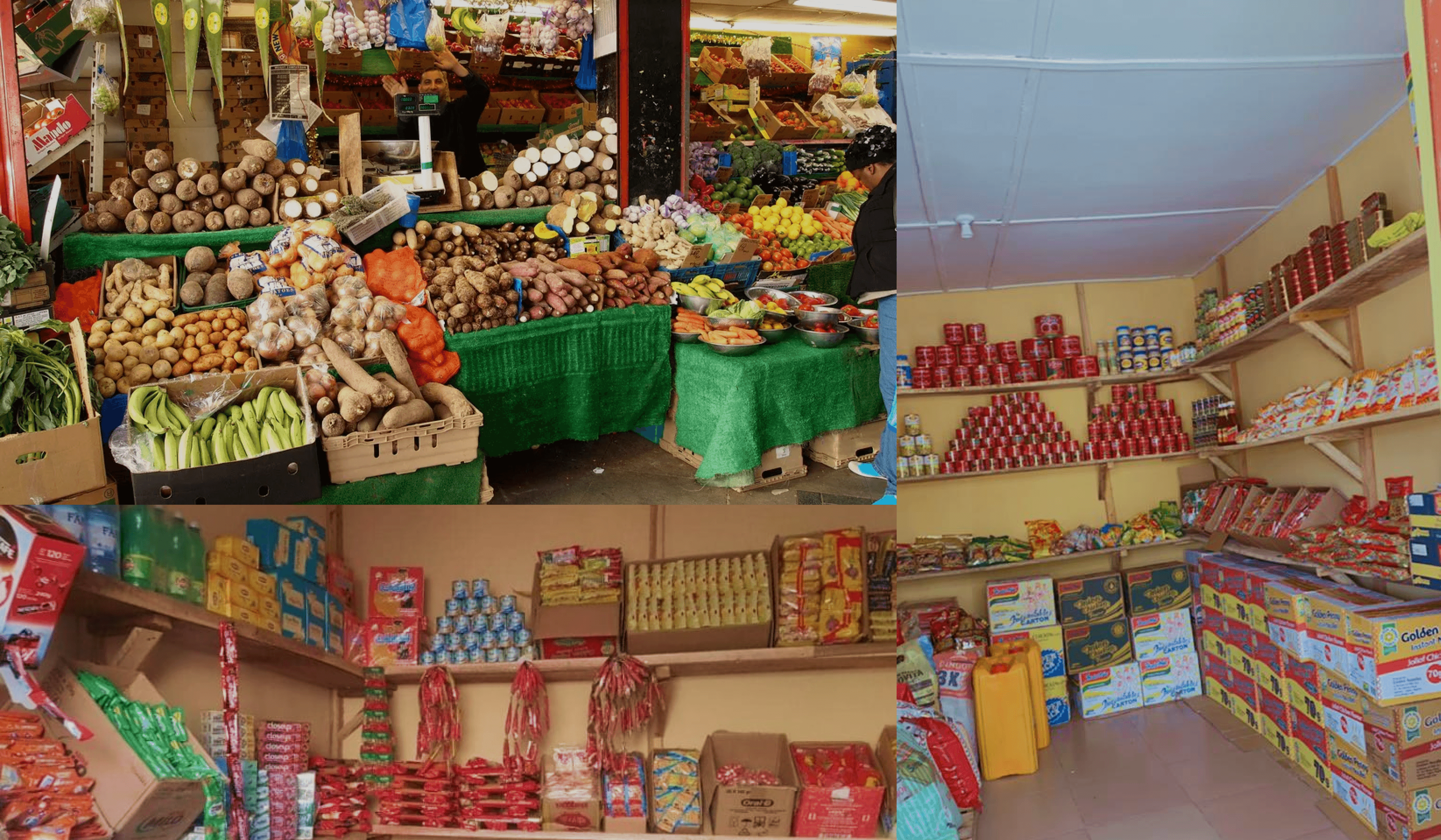
Research Photos, Lagos Markets
Field visits to Mile 12, Oyingbo, and Ketu markets
"The moment you remove negotiation from a Nigerian market, you have removed the humanity from the transaction."
— Research Participant, Oyingbo Market
Three key themes emerged from the research:
Negotiation Is Culture
Not a feature request. Buyers expect to haggle and feel cheated when they cannot.
Sellers Need Intelligence
Most run on gut feel. They want data but do not know how to ask for it.
Trust Is Fragile
Sellers have been burned by tech platforms before. Onboarding needs to earn their confidence.
Time Is Money
Riders optimize instinctively but need tools to batch orders efficiently.
Key Design Decision 01
Why Location-Based Pricing Was Always the Plan
Here is something I want to be clear about: location-based pricing was in the plan from day one. It was not something we discovered we needed after launch. We knew going in that we had to prevent buyers from gamifying the system.
The scenario we wanted to avoid: a buyer sees tomatoes listed at ₦500, knows they can negotiate, and throws out ₦100 hoping the seller is desperate enough to accept. That is not negotiation, that is exploitation. And it wastes everyones time. The seller has to review and reject, the buyer gets frustrated, and the platform looks broken.
The solution we are building is what I call a community price floor, a dynamic anchor that keeps negotiations within a reasonable local range while keeping the haggling dynamic alive. Think of it like guardrails. Buyers can still negotiate and feel like they got a deal, but they cannot waste a sellers time with unserious offers. If tomatoes are ₦500 in Victoria Island, you can bargain down to maybe ₦400, but you cannot ask for ₦100.
This is still in active development, so I cannot give you hard numbers yet. But early co-design sessions with vendors in Lagos have been promising. The feedback keeps pointing to the same thing: design decisions have to respect local context. What works in San Francisco will not work in Surulere. That is not a bug. It is the whole point.
Key Design Decision 02
Designing the AI Seller Dashboard
The conventional wisdom says small vendors are afraid of AI. In my experience, that is only true if you show them a chatbot first. Show them something useful, like "here is what people in your area are buying right now," and they get it immediately.
After sellers verify their store, they get access to an AI-powered dashboard that guides their entire journey. I spent a lot of time thinking about what to prioritize here, and it came down to reducing uncertainty:
Inventory AssistantAI
AI looks at the sellers location, how much capital they have, and their power supply situation to suggest what items they should stock, backed by real demand data.
Video VerificationAI
Geolocation-locked video uploads. Sellers record at their actual store location. Keeps the platform honest without being intrusive.
Store InsightsAI
Real-time nudges when inventory is running low, items are about to expire, or prices are out of sync with the market.
AI OptimizerAI
Analyzes performance patterns and suggests what to restock, what new products to try, and honestly, what to stop selling.
What I love about this setup is that the AI does not try to replace the sellers intuition. It augments it. A tomato seller in Mushin who has been doing this for fifteen years knows things the data does not. But the AI can tell her something she might not know, like the fact that demand for bell peppers spikes every Thursday in her area. That combination of intuition plus data? That is the sweet spot.
Bringing It Together: The Three-Sided Design
Three-sided marketplaces are tricky because each user has diametrically opposed needs. Buyers want low prices and speed. Sellers want profitability and simplicity. Riders want batch efficiency. If you optimize for one at the expense of the others, the whole thing falls apart.
My approach was to give each persona their own tailored interface, with AI doing the heavy lifting in the background to keep things balanced.
Buyer Experience
The buyer app is designed around one core action: getting what you want at a price that feels fair. Not the lowest price, just a fair one. Before buyers can start shopping, they go through a lightweight onboarding that sets expectations and builds trust from the start.
Frictionless Onboarding
Phone number sign-up with OTP, then a quick tutorial that explains how negotiation works on BringGoods — so buyers know what fair pricing looks like before they start.
Price Setting & Bidding
Tap an item, pick the size or variant you want, then name your price. The system applies the community floor so offers stay reasonable.
Seller Responses
Sellers can accept, counter, or let offers expire. Creates healthy competition.
Smart Checkout
Full cost breakdown before confirmation. Address locks after pre-calculation.
Real-Time Tracking
Processing to Packing to Dispatch. Visible at every stage.
Buyer App — Onboarding & Shopping Moments
Seller Experience
For sellers, the priority was making them feel in control while giving them tools they had never had before. The AI suggestions are just that: suggestions. The seller always makes the final call.
AI OnboardingAI
Smart recommendations from day one based on their location and profile.
Verification
Video proof at their store location. Builds trust for buyers.
Quick Processing
Swipe "Ready for Pickup." Five minutes, done.
AI OptimizerAI
Restock recommendations, expansion ideas, and performance trends.
Seller App — Onboarding & Store Management Moments
Rider Experience
Riders are the backbone of the operation. If they are not efficient, nobody gets their food. The rider interface focuses on maximizing earning potential per trip.
Multi-Order Batching
Accept up to 3 orders at once. System optimizes the route.
Smart Routing
Pickup sequence optimized for minimal backtracking.
Verification System
Confirm arrival, scan pickup codes, verify items with sellers.
Rider App — Onboarding & Delivery Moments
BringGoods Admin Console
I designed the BringGoods Admin Console as the mission-critical command center for our operations team and management to monitor and control the entire three-sided marketplace in real-time. This centralized dashboard serves as the nerve system that keeps buyers, sellers, and riders coordinated while maintaining marketplace health and trust.
Real-Time Marketplace Monitoring
The dashboard surfaces critical KPIs including total orders, completion rates, average delivery times, and active orders in progress. Operations teams can instantly spot bottlenecks and intervene when needed.
User Management & Verification
Comprehensive oversight of buyer, seller, and rider onboarding with approval workflows, verification tracking, and churn analysis. This reduces fraud and maintains platform quality.
Financial Operations Center
Complete financial oversight including GMV tracking, seller/rider payouts, refund management, and commission monitoring. Ensures transparent and timely settlements across the marketplace.
Performance Analytics
Deep insights into rider efficiency, delivery accuracy, customer ratings, and platform uptime. Data-driven decision making to optimize marketplace operations.
The admin console uses role-based permissions to protect sensitive data while enabling customer support teams to resolve disputes quickly. By centralizing operations, it allows BringGoods to scale efficiently while maintaining the quality and speed that defines our "before kettle boils" promise.
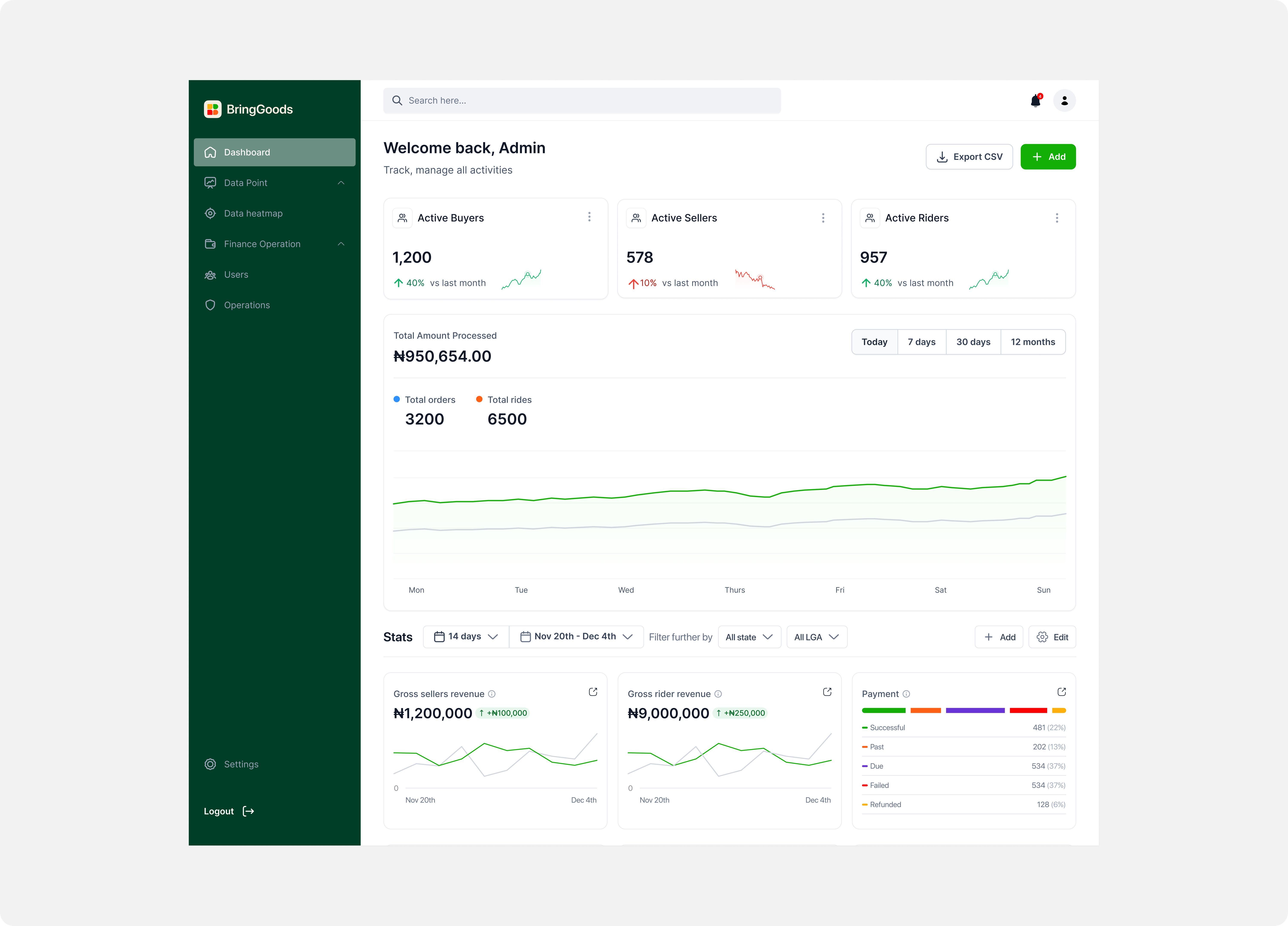
Admin Console
Dashboard & Analytics Views
BringGoods Academy
Recognizing that many potential sellers lacked e-commerce experience, I designed the BringGoods Academy as both a training hub and strategic onboarding tool. This separate platform provides free business education before introducing sellers to our marketplace, ensuring they have the skills needed to succeed.
Dual-Purpose Education Strategy
The Academy serves two interconnected goals: first, it provides comprehensive business training on topics like product selection, pricing strategies, order handling, customer service, social media marketing, and compliance. Second, after completing the free training, participants learn how to leverage the BringGoods platform specifically for their business growth.
Business Fundamentals Training
Comprehensive modules covering product selection, competitive pricing, inventory management, customer service excellence, and digital marketing basics — essential skills for marketplace success.
Platform Integration Pathway
Seamless transition from general business education to BringGoods-specific training, including account setup, product listing optimization, and seller tool utilization.
Interactive Learning Experience
Video tutorials, knowledge-testing quizzes, and certification programs that ensure participants truly understand both business principles and platform mechanics.
Compliance & Quality Focus
Special emphasis on food safety standards, business regulations, and marketplace policies — crucial for fresh food sellers in Nigeria's regulatory environment.
Target Audience & Impact
The Academy primarily serves aspiring entrepreneurs with little business experience, first-time e-commerce sellers needing guidance, and existing market traders wanting to digitize their operations. By providing free, comprehensive education, we ensure sellers enter the marketplace prepared for success rather than learning through costly mistakes.
"The BringGoods Academy taught me everything I needed to know about running an online business. After completing the program, setting up my store was so much easier — I already understood pricing, customer service, and how to use social media to grow my sales."
— Kemi Adebayo, Fresh Produce Seller, Academy Graduate
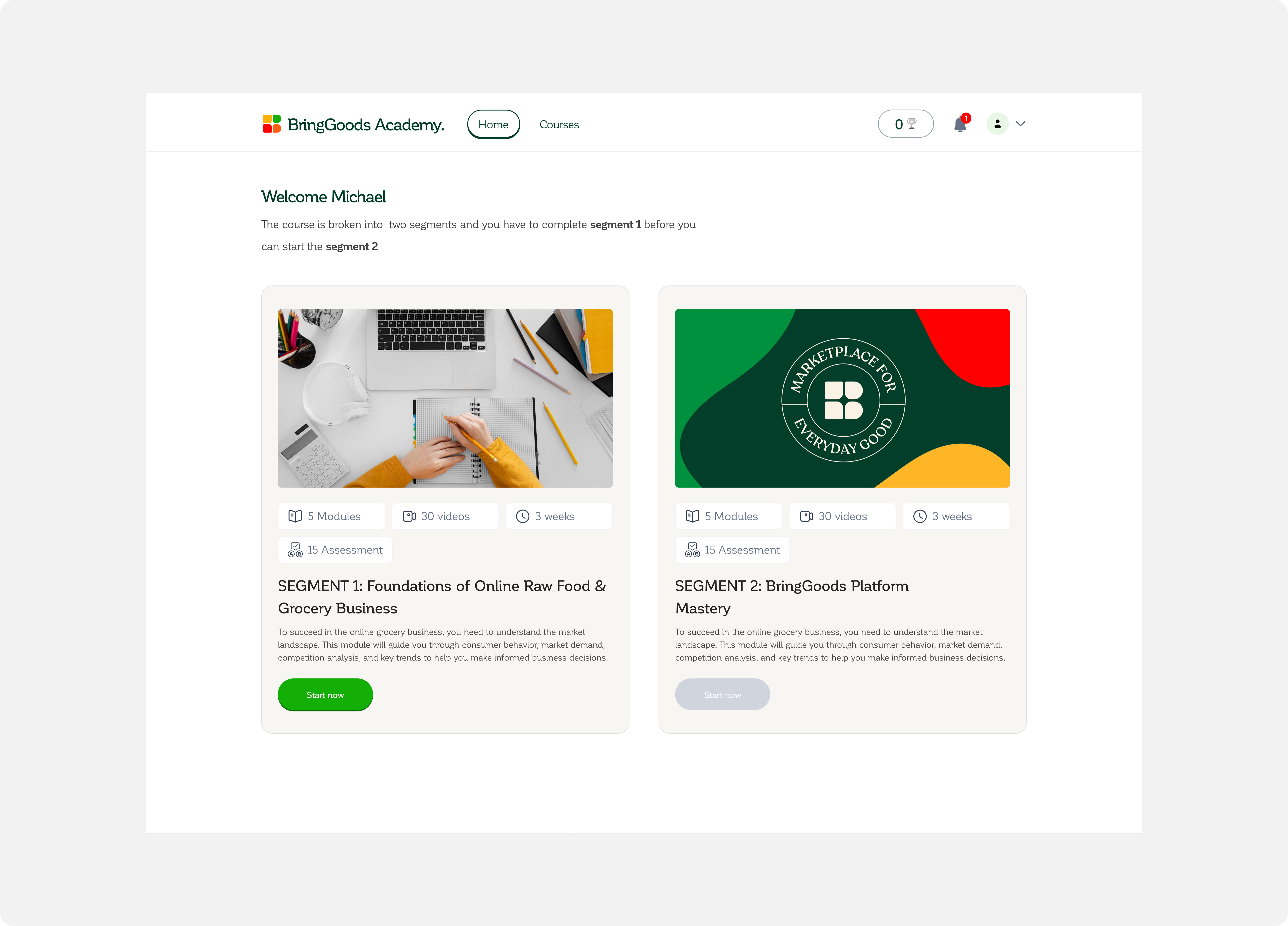
BringGoods Academy
Course Interface
This educational approach differentiates BringGoods from competitors by investing in seller success rather than simply providing a platform. Well-trained sellers provide better service, leading to higher buyer satisfaction and stronger marketplace growth.
Key Design Decision 03
The Iteration That Shaped the Product
The negotiation flow went through three completely different versions before we landed on something that worked. And honestly? That is totally fine.
V1: Buyers set a price, sellers accept or reject. Simple, clean, and it failed spectacularly in testing. 30% acceptance rate. Sellers felt like they had no agency. They either took the offer or got nothing.
V2: Added counter-offers. Acceptance jumped to 60%, but now a new problem emerged: sellers felt rushed. They would get a notification and had to respond quickly or risk losing the sale. Some sellers told us it felt stressful, which was the opposite of what we wanted.
V3: Quick accept buttons for sellers who want to win fast, plus automatic pricing rules for sellers who do not want to engage with every single offer. Acceptance hit 92% with test users. More importantly, sellers reported feeling in control again.
The lesson here: iteration is not scope creep, it is the actual design process. Test something, watch what happens, trust the data, evolve. Every version taught us something the previous one could not.
Key Design Decision 04
Trust Lives in the Details
Beyond the core flow, I added features that make the platform feel human. Not everything needs to move a metric. Some things just need to make someone feel looked after.
BringGoods Academy
Free business training for sellers before they start. Helps them understand digital commerce on their own terms.
Real-Time Tracking
Processing to Packing to Dispatch. Target: 45% fewer support tickets.
Admin Console
Operations dashboard for monitoring marketplace health. We need to see what is working.
Pickup Verification
Codes at pickup prevent wrong orders. Small thing, huge trust builder.
These features do not drive the primary metrics, but they create emotional value. The goal is for users to feel cared for, not just served. That distinction matters a lot more than most product teams realize.
Target Outcomes
We are still building, so I cannot claim these as results yet. But these are the targets we are designing toward, the North Stars that guide every decision:
| Metric | Current Reality | Target |
|---|---|---|
| Delivery Time | 2-4 hours | Under 30 min |
| Price Control | Fixed only | Buyer negotiation |
| Seller Decisions | Pure intuition | AI-powered insights |
| Rider Batching | Single orders | Up to 3 at once |
| Seller Reach | Physical store only | Digital marketplace |
Building something ambitious?
Whether you're launching from scratch or refining an existing product, I'd love to hear what you're working on.